Suppose you kept a pine cone on the porch to tell you when to bring the washing in. One morning its scales draw together. You take in the shirts. By lunchtime the sun is out and the path is bone-dry. Was the cone wrong?
About the washing, perhaps. About the porch, it may have been quite right. The woody scales take up moisture and bend inward. As they dry, they spread apart again. That response survives the trip from branch to forest floor to porch rail. A fallen cone can go on registering changes in its surroundings after the living cells that built its scales are gone.
Which one sat in humid air?
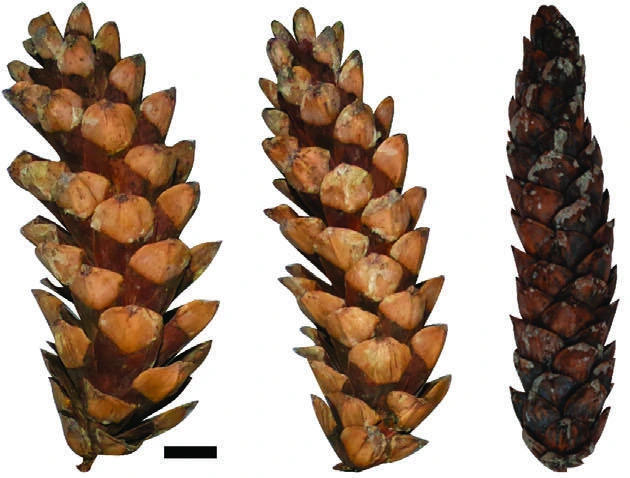
Carmen Eger and her colleagues photographed a Himalayan blue pine cone under three conditions. One view shows dry air. Another shows what happened after seven hours in air at 80% relative humidity. For the third, the researchers soaked the cone in water. Before opening the labels, look at the gaps between the scales. Which outline would you pick for the humid air?
Reveal the three conditions
Left: open in air at 30% relative humidity. Middle: slightly closed after seven hours at 80%. Both air observations were at 23 °C (73 °F). Right: fully closed after soaking in water.
The middle photograph is the one to spend a moment with. If you saw that cone by itself, you might reasonably call it open. Set it beside the drier one and you can see the tips have shifted. A cone gives you plenty of positions between open and shut. That makes a change in the same cone easier to recognize than a change in weather inferred from whichever cone you happen to pick up.
The bend begins near the base
Pick one scale and follow it from the pointed tip down to the place where it joins the cone. That base does much of the bending. Neighboring tissues there change length by different amounts as moisture enters or leaves their cell walls. Because the tissues are joined, the difference makes the scale curve. A modest bend near the attachment carries the tip through a much larger sweep, where you can see it without a microscope.
You can take the tree out of that explanation and even take away the rest of the cone. Researchers who examined Monterey pine found that a detached seed-bearing scale still moved when they changed the relative humidity around it. Everything needed for that movement was in the piece they held. On the tree, the consequence is bigger than the bend. Gaps between dry scales give the winged seeds a way out when the wind can carry them.
The morning the washing could stay out
Relative humidity compares the water vapor in the air with the amount needed for saturation at that temperature. A cool morning and a warm afternoon can have the same amount of water vapor and quite different relative humidities. As the air cools overnight, relative humidity can rise enough for a cone to take up moisture. All of that can happen under a clear sky. Rain requires something else to happen overhead, where droplets or ice crystals in a cloud grow large enough to fall.
There’s a way to give the porch test a fair hearing. Start with a fallen cone whose scales are already spread. Set it somewhere outdoors that’s sheltered from splashes, and photograph it from the side. Choose one gap you can find again. Check it at roughly the same hour over several days. If it narrows, write that down before you look up the forecast. Later, add whether rain actually fell at your spot that day. Keep the dry days in the record. They’re the ones you’re most likely to forget if the cone once happened to close before a downpour.
You’ll end up with two observations worth keeping apart. One tells you what happened to a little piece of wood on your porch. The other tells you what fell from the sky. The morning those entries disagree is the morning the cone has the most to teach you.