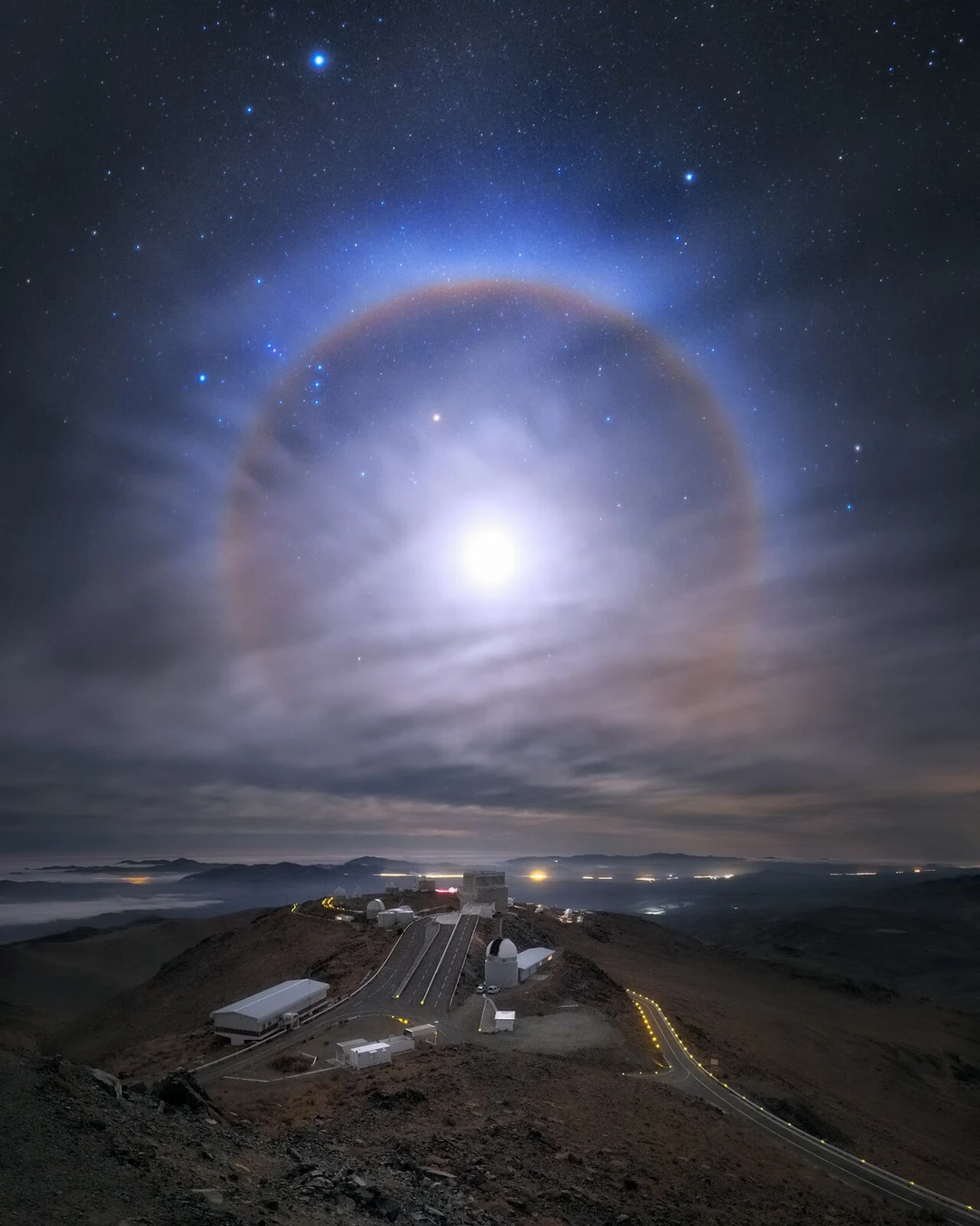
Start at the top of the photograph. That blue-white point a little left of center is Sirius, the brightest star in the night sky. Work down toward the Moon and you’ll pass other stars, a broad luminous arch and a narrow rim the color of weak tea. With that many stars showing, it would be easy to call this a clear night. The ring gives the cloud away.
Yuri Beletsky photographed the scene above La Silla Observatory in Chile. For an astronomer hoping to measure the light from a faint star, that ring is bad news. Something overhead is bending moonlight into the field of view. Down in the valley, somebody looking at the same sky might have a more familiar question. Will it rain tomorrow?
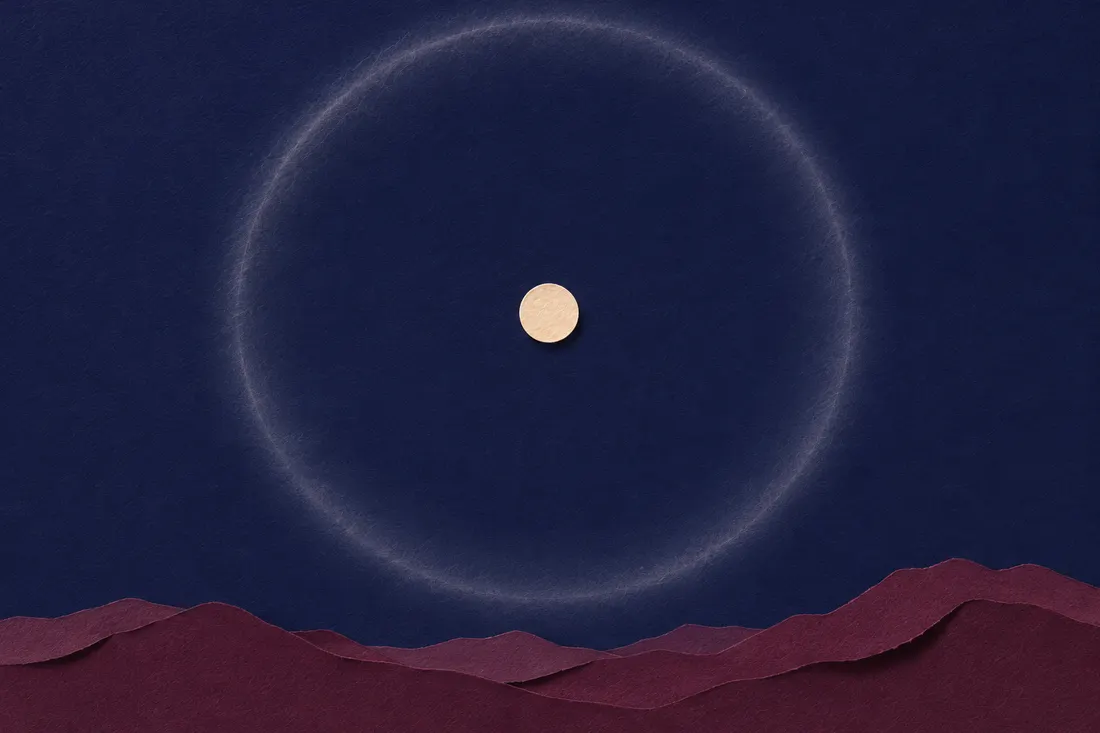
Show the 22° radius
The line runs from the Moon’s center to the inner rim on the right. From one side of the ring through the Moon to the other side is twice that angle, about 44°.
Where are the 22 degrees?
People call this a 22-degree halo. The measurement starts at the middle of the Moon and ends at the inside edge of the ring. It’s an angle you could sweep out by pointing first at one and then at the other. Open the guide on the photograph and notice how little of the full circle its line crosses. Twenty-two degrees gets you halfway across.
Your hand makes a serviceable night-sky ruler. Hold one arm straight out, spread your fingers and cover the Moon with your thumb. For many people the tip of the little finger will fall near the inner edge of an ordinary halo. Hand sizes vary, but the gesture gives you the right sense of scale. Bring your hand back to your face and it takes up a much bigger piece of sky. Arm’s length is part of the measurement.
That span helps sort out two things people quite reasonably call a moon ring. Sometimes the Moon wears a small, bright collar, perhaps with bands of color crowded close around it. That can be a corona. Light spreading around tiny particles, often water droplets, produces those close rings. The innermost set is usually no more than about five degrees all the way across. The great arch at La Silla measures about forty-four degrees across. You can make that distinction in the yard even on a night when neither ring shows much color.
Why the rim has an inside edge
High above the telescopes, moonlight was passing through ice crystals. A six-sided crystal can act like a little prism. Light changes direction as it enters one face and changes direction again on the way out. For the path that makes this halo, the smallest turn is about 22 degrees. Many rays emerge close to that angle. With crystals tilted in all directions, light can reach the observer from positions all the way around the Moon.
Look at the top of the arch again. The rim has a fairly definite inner border, then it fades outward. The geometry of the crystals gives the light a place to start piling up. Red light bends a little less than blue, which is why a reddish fringe can mark the inside. Now follow the arc down toward the observatory. It gets hard to trace near the bottom. A stretch of thin ice cloud in one part of the sky can draw a handsome arc even when the rest of the circle is missing from view.
What to look for an hour later
The rain saying owes its life to a particular sequence of clouds. As a warm front approaches, the first arrival can be a thin veil of high ice cloud called cirrostratus. It can let plenty of moonlight through and still make a halo. As deeper layers of cloud move in, the Moon grows harder to pick out. Rain or snow can follow. On a night that unfolds this way, someone with an eye on the Moon gets a glimpse of the system well before the first drop hits the step.
So take a second look an hour later. Has the thin veil spread? Are stars that you could pick out earlier disappearing across more of the sky? Or has an edge of the cloud slipped past the Moon and left it shining cleanly again? Those are two quite different ways for a ring to vanish. Losing sight of it, by itself, tells you remarkably little.
The next morning’s rainfall is one thing you can’t read out of the La Silla photograph. Now go back to Sirius at the top. Even that brilliant point of light could have fooled you about how clear the night was. It took the faint rim halfway down the picture to show you the ice.