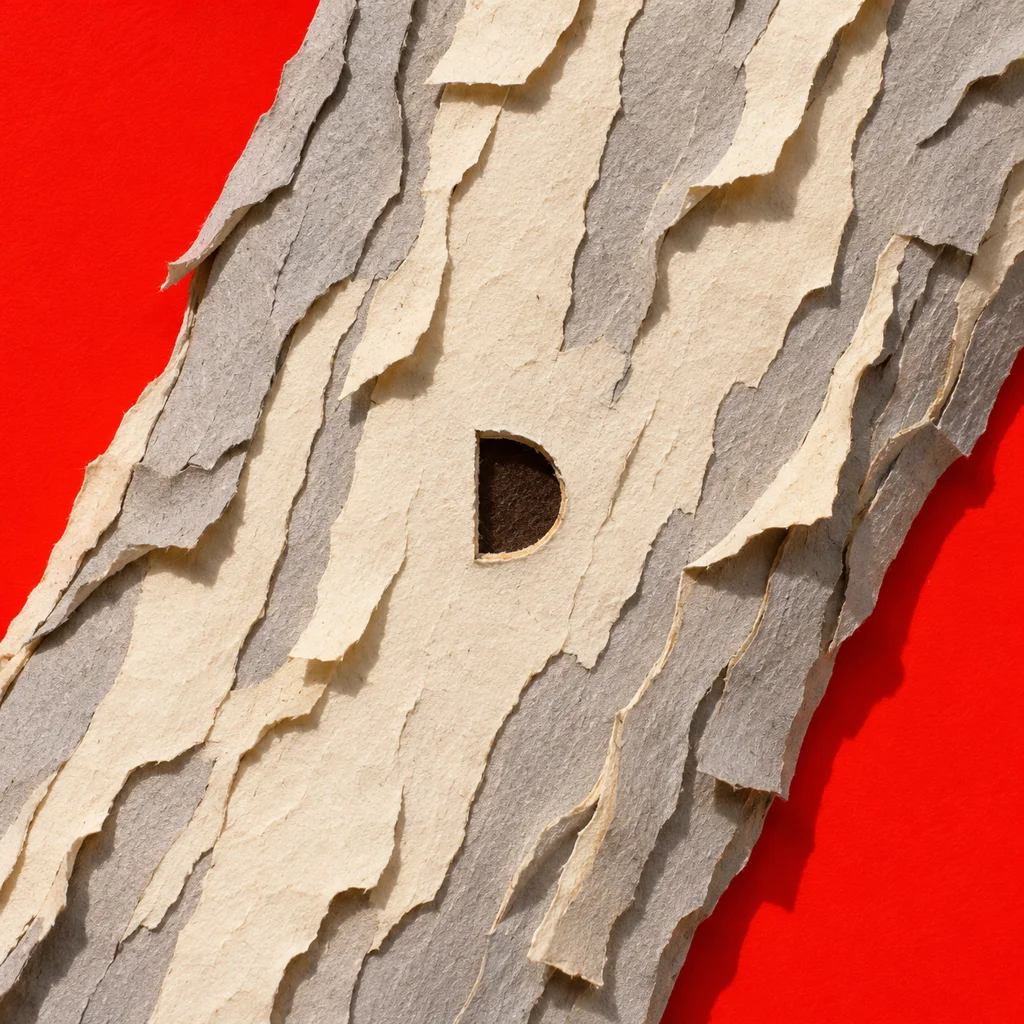
The ruler starts just below a dark hole in gray bark. Three little spaces span the opening. One edge is nearly straight, as if someone had pressed a thumbnail into the bark and lifted it out. In the next photograph the ruler ticks are just as close together, but now it takes six spaces to get across the hole. This edge curves all the way around.
Ohio State entomologist Daniel Herms put the photographs side by side in a field guide to insects that bore into ash. The trees in both pictures have lost a tenant. One was a beetle. The other, despite the word borer in its name, was a moth. Here are the two openings drawn to the widths in the guide. Their order is yours to work out.
Which opening fits the beetle?
One was left by an emerald ash borer, the other by a banded ash clearwing moth. Both drawings use the same ruler. Count the spaces across each opening and look for an edge you could lay a straight pin against.
Original Stray Press diagrams using the shapes and widths reported on Ohio State’s comparison plate. Each small ruler interval represents 1 mm.
Check the two openings
A is the moth’s exit. The continuous curve and the six ruler spaces go together.
You found the beetle’s exit. The short, straight side is easiest to pick out on the left of B.
Opening B is the 3 mm D left by the adult emerald ash borer. Opening A is the banded ash clearwing moth’s round, 6 mm exit. Its width would accommodate two of the smaller openings side by side. Compare the left and middle photographs on page 3 of the Ohio State guide (download PDF). The labels continue on page 4.
The penny beside the hole
Enlarge the hole and see the 5 mm scale
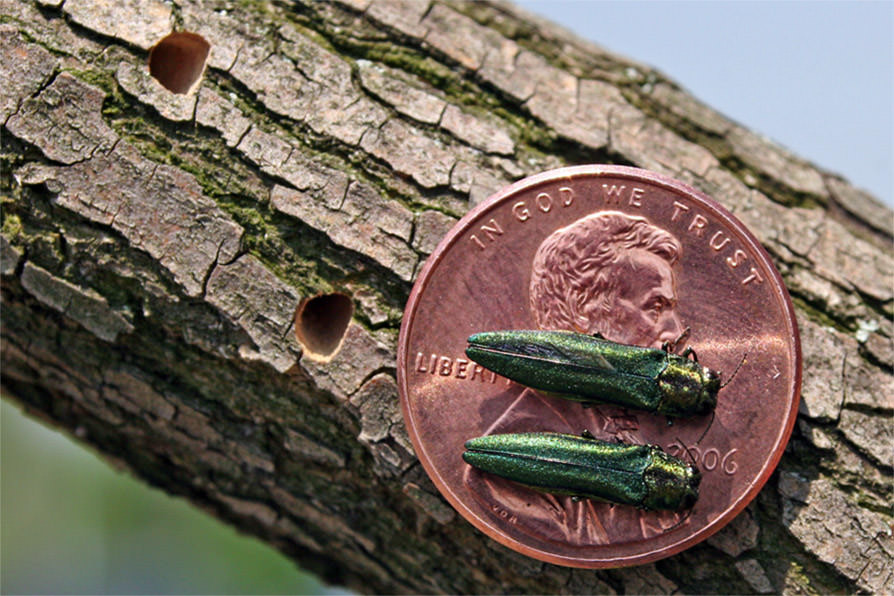
Stray Press used the penny’s diameter to draw the 5 mm bar. The coin sits slightly above the curved bark, so the scale is approximate.
In Leah Bauer’s photograph, the easiest things to spot are the two green beetles perched on Lincoln. Look just left of the word LIBERTY. There’s an empty opening, with a pale lip along its lower edge. Farther up the same piece of wood is another. Each makes more sense as a capital D if you let the letter lean. There is no rule that the flat edge has to stand upright on the tree.
The penny lets you make a rough measurement even if you have the picture enlarged on a phone. The longer span of the opening nearest the coin would fit across Lincoln’s penny about six times. A cent is a little over 19 millimetres across, which puts the opening in the neighborhood of 3 millimetres. The curve of the bark and the angle of the coin cost us some precision. Herms’s ruler gives us an independent check on a different example.
The beetle that makes this mark is the adult emerald ash borer, Agrilus planipennis. By the time it opens a door to daylight, it has finished feeding as a larva under the bark and changed into a winged adult. The wandering tracks you sometimes see on a patch of exposed wood belong to the earlier part of its life. A larva chewed those passages as it fed and grew. The neat little D marks the adult’s departure.
Something can be left in the doorway
The banded ash clearwing, Podosesia aureocincta, leaves a different souvenir. Sometimes a thin brown pupal case sticks out of the round hole after the moth has gone. It can look as though an insect is still wedged there. The moth has slipped free of the shell it wore while changing into an adult. Herms’s guide shows one of these cases still caught in the bark. An empty case at the rim gives you a second clue when the edge itself is chipped.
Step back a pace and the two insects can leave different evidence underfoot, too. A clearwing caterpillar pushes chewed material out as it bores. The debris can collect in a bark crevice or around the foot of the tree. An emerald ash borer larva packs much of its debris into its winding passage beneath the surface. An otherwise tidy trunk can have a great deal going on under the bark.
The part the close-up leaves out
Crop the ruler photograph down to the dark shape and you lose a useful fact: what tree was it? On a leafy twig of a true ash, look for whole leaves paired opposite each other. Each leaf has a central stalk carrying several leaflets. Follow that stalk back to the twig before deciding what counts as a leaf. Boxelder can fool you on both features. When fruits are present, the paired wings of boxelder and the single paddle-shaped fruits of ash make a handy cross-check.
The host, the size and the outline together make a better field note than the letter D alone. Even among borers associated with ash, Herms mentions a smaller relative found in little branches and twigs. If you come across a promising mark, a close photograph with a scale and a second view showing the twig or trunk preserve two things a tight crop loses. To try the identification at walking distance again, return to the circled hole in our tree-marks story.