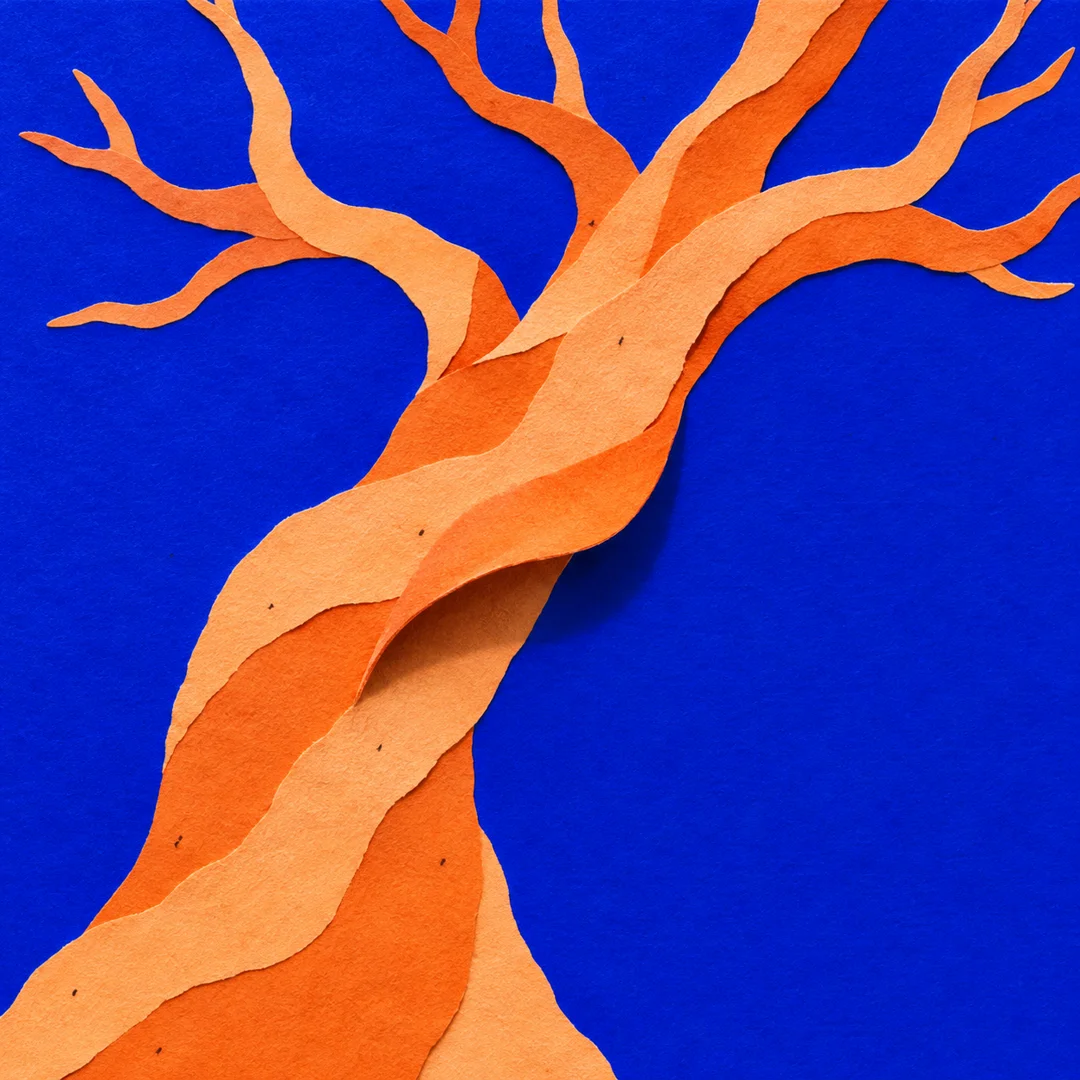
On May 19, 1993, in northern Michigan, a patch of little holes on a living tree was worth drawing. On May 20 it was worth drawing again. By May 22 the upper edge had changed enough that you could put the drawings in order. Which end of a row would you watch if you could come back tomorrow?
Two other trees pose different puzzles. On one you could cover the important clue with a pencil eraser. At the foot of the other, the whole trunk looks like a pencil somebody stopped sharpening. These three records come from different places and years. You can try them in any order. Pick a maker, then open the answer to see what the observer had to go on.
A trunk ruled in holes
Follow one chain of openings from the bottom up. Its neighbor starts a little higher but runs much the same way. Put your finger over all but one opening and much of the clue disappears.

Reveal the maker for a trunk ruled in holes
Look again. Count how often the maker came back to the same small patch.
You spotted it. The bird worked its way up the trunk, one opening at a time.
Look again. Look for narrow gaps of intact bark between the openings.
A yellow-bellied sapsucker made the wells. Eberhardt watched these woodpeckers open small horizontal ovals in living bark. A bird returned to cut a little more from the upper edge. When it started the next well, it placed it within half a centimetre of the top of the last one. Several chains side by side could turn a patch of bark into something resembling a scorecard.
The bird had tapped the phloem, the living tissue that carries sugars through a tree. In the four patches Eberhardt followed day by day, the wells that still yielded sap were at the tops of the chains. An individual hole gave sap for about three days on average. If you had just one afternoon to watch, the upper edge would be a good place to settle your binoculars. Try it with Eberhardt’s four-day sap-well record and see which holes were still flowing the next day.
Her study included paper birch, red maple, juneberry and bigtooth aspen. For a different tree with a real row you can trace, find the West Indies mahogany in the Everglades bark photographs. Insects and hummingbirds also come for the sap. A hummingbird drinking there would tell you the well was open. It would take another observation to catch the bird that drilled it.
A tiny D in ash bark
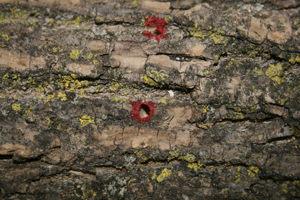
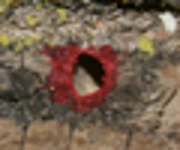
Somebody has done you the kindness of circling two places to look. Ignore the red paint for a moment. In the lower ring, trace the dark opening. How far can you follow its edge before it changes from straight to curved?
Reveal the maker for a tiny d in ash bark
Look again. A bird searching for a meal can leave jagged openings nearby. Trace the edge inside the lower ring.
Look again. A round drill bit would have a hard time accounting for that flat side.
You spotted it. The flat edge and the rounded one outline the adult’s way out.
An adult emerald ash borer chewed its way out. The National Park Service identifies the opening in Sue Ford’s photograph. The D is easiest to see if you allow the letter to tip on its side. The paint ring is enormous by comparison, and the park gives a typical width of barely an eighth of an inch for the exit itself.
How much difference does a ruler make? Compare the beetle’s exit with a clearwing moth’s, then look for the D beside Lincoln’s penny.
Most of the beetle’s work happens out of sight. As a larva it feeds beneath the bark, leaving a winding passage that widens as it grows. Those passages can interrupt the tree’s supply of water and nutrients. A woodpecker going after a larva can leave a ragged opening in the very same trunk. Which animal you name depends partly on which opening you put your finger on.
In summer 2017 a park forest crew examining mature ash at the Roosevelt-Vanderbilt historic sites in New York saw a combination of clues: numerous D-shaped exits, cracked and pale patches of bark, and dead sections overhead. Ford’s photograph is a separate record. On a walk, give a tiny D that same wider view. Get the tree in the picture and look up into its crown. Drought and other troubles can thin an ash crown too.
A birch sharpened to a point
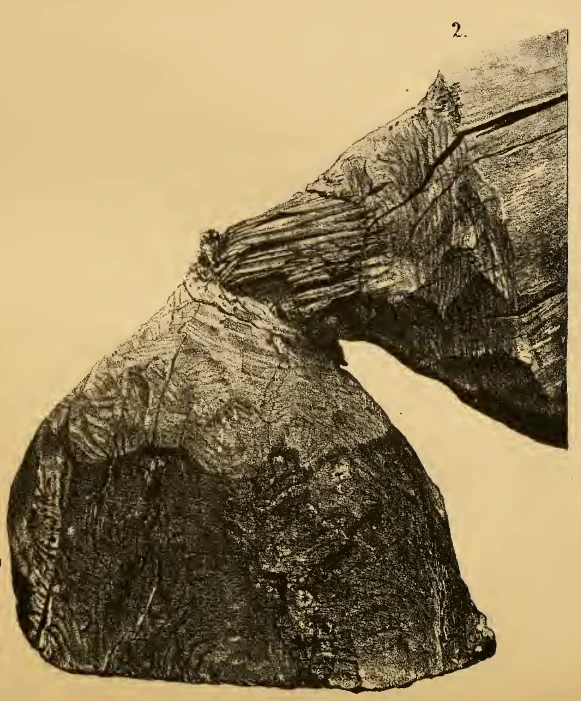
Start at the bark near the base and work upward. The trunk narrows sharply. Just where you expect to run off the tip, there is more tree, bent away at an angle. Both halves came out of the woods together.
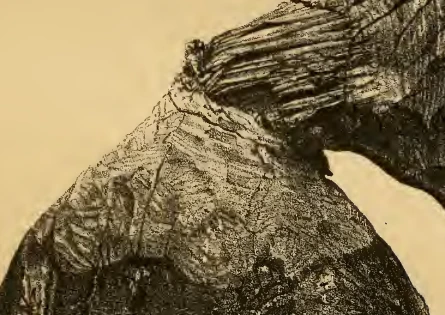
Reveal the maker for a birch sharpened to a point
You spotted it. The sloping cut goes deep into the wood. Look at the narrow bridge the teeth left behind.
Look again. Follow the cut past the missing bark and into the solid trunk.
Look again. Look for the many small cut faces around the narrowing neck.
A North American beaver cut this yellow birch. On the shore of Grass Lake in Michigan, the falling tree lodged against an obstacle. A strip of wood held. When Lewis Henry Morgan collected the cutting in 1861, he could carry away both the tapered stump and the matching end of the fallen trunk, still joined at their tips.
Morgan measured the specimen just below the cut: seventeen inches across. The lowest cutting began six inches above the ground. Across that band, the short faces in the wood let you follow a succession of bites. Morgan also examined loose chips. On a separate chip he counted six cuts at one end and eight at the other. Look closely at Morgan’s chip and see if you can find where the wood split.
The deepest cut on the birch faced the pond. Morgan wondered whether the animal had meant the tree to fall that way. He had the wood in his hands and still had to guess at the intention. Beavers eat the tender layer under bark and use branches for food, dams and lodges. To find out what became of this particular tree, the best evidence is that stubborn little hinge.
What to bring back from a walk
If you had room for just two photographs, take the first from a few steps back. Include the branch the holes run up, the crown above the ash, or the bank beside the stump. Come close for the second. Put a ruler beside the mark if you can reach it from the ground, and keep the whole edge in the frame. A tight crop makes a fine puzzle. The wider picture may hold the very thing that lets someone solve it.
One more observation costs nothing and is easy to forget: jot down which edge you expect to change. Eberhardt could say which way a patch of holes grew because she went back to it. For something you can watch change a little closer to the ground, try the pine cone that closes when it gets wet.