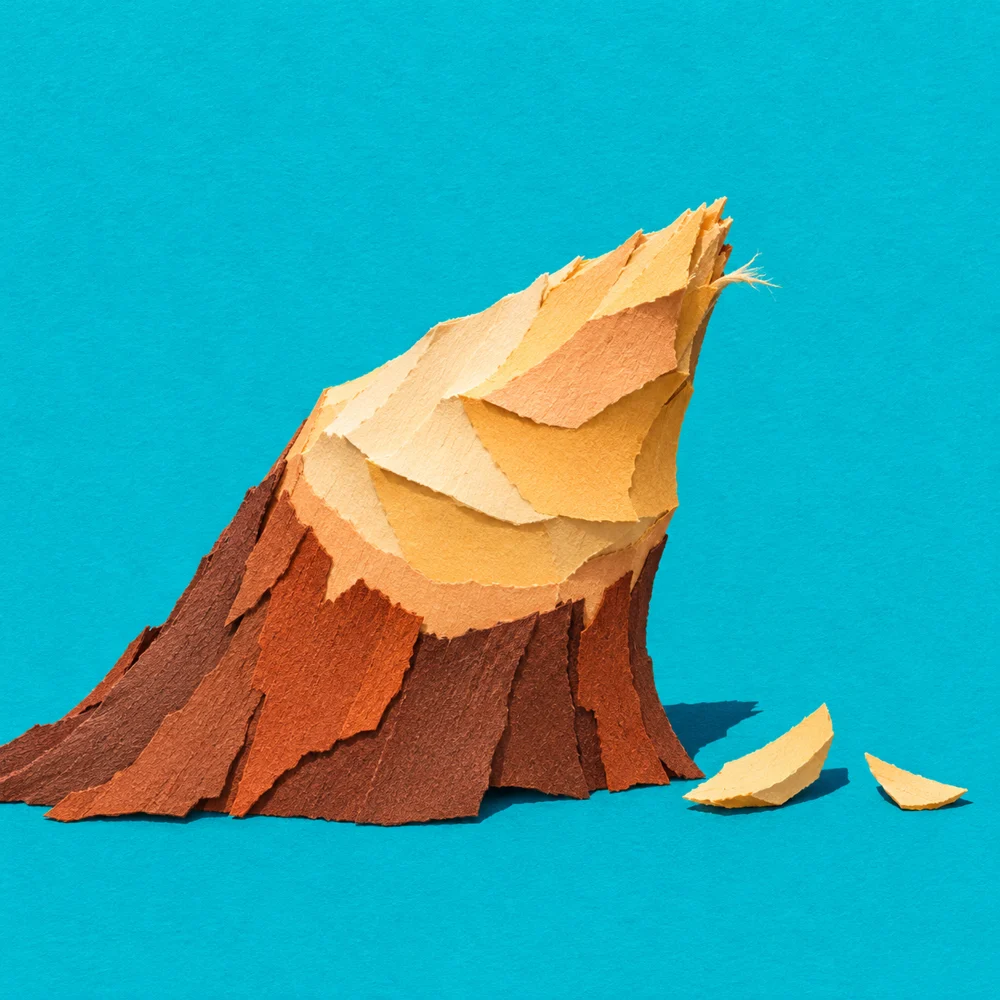
On the south shore of Lake Flora in Michigan, a yellow birch had an eight-inch band of fresh tooth marks around its trunk. There was still enough wood in the middle to hold the tree up. In October 1862, some woodsmen told Lewis Henry Morgan about it. He went out and took the cut section home. He brought back something harder to find than a pointed stump. He got the other half of the point.
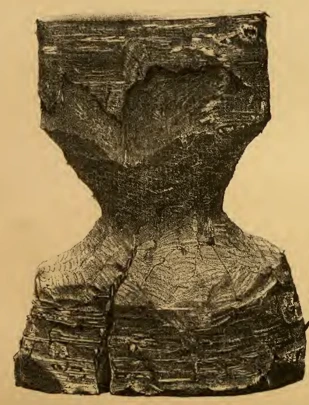
Cover the top half of the engraving with your hand, down to the narrowest part. What remains looks much like the end of a pencil. Lift your hand and you can see where the shape came from. Each time the beaver took wood out of the side of the standing tree, it cut into the trunk above the bite as well as below it. Bites from different sides narrowed the wood between those two slopes. Once the trunk gives way, the lower slope stays rooted in the ground.
Morgan measured thirteen and a half inches across the birch just below the cut. He could see tooth marks all the way around. He also said plainly that he had never seen a beaver fell a tree. The wood could tell him which sides the teeth reached. It couldn’t tell him how many times an animal went around, or whether a second beaver took a turn.
Where the wood let go
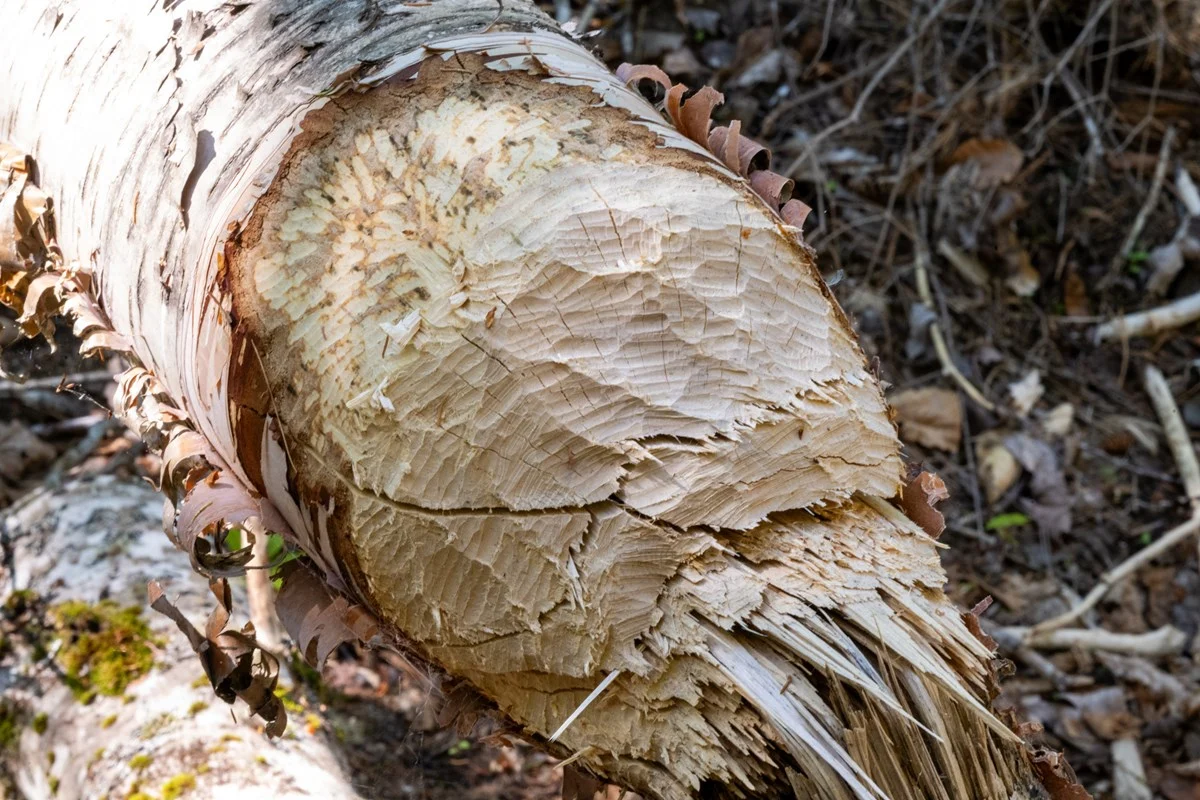
Start at the dark curl of bark at the top right of the Maine photograph. Just below it are little scoops in the pale wood, wide enough to catch the light on one edge. Follow them down until the texture changes. Long splinters stick out at the lower right. The scoops record the gnawing. The splinters show what happened to the fibers that still joined the two pieces when the wood broke.
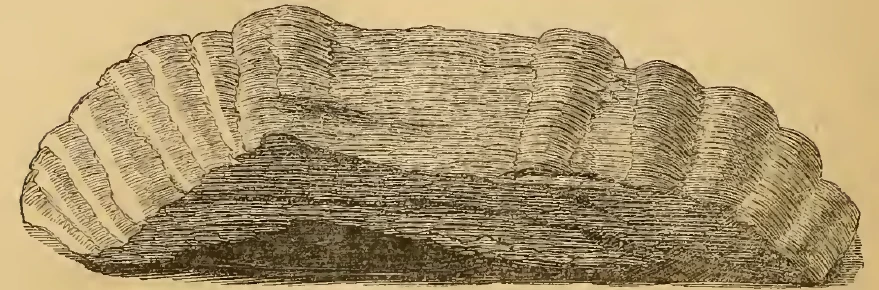
Something similar can turn up at your feet. A freshly worked trunk often has chips scattered around its base. Morgan kept an assortment and had the inside face of one drawn for his book. Here it is, enlarged. It came from his collection; he gave no collecting place for this particular chip.
Where did this chip split along the grain?
Look at the sloping faces near each end, then follow the fine lines across the middle. Which part came free by splitting?
Read the marks
Those scoops are a good place to find a tooth mark. Follow the ridges toward the middle until they run out.
Yes. The long lines in that middle patch follow the wood grain.
The chip split in the middle. Morgan counted eight cuts at the thicker left end and six at the right. A few were only half a tooth wide. He tried a beaver skull against the chip and found that a lower incisor fitted the individual cuts. Between the two sets of bites he measured a split surface less than an inch long. The teeth had cut in from either end. The grain supplied the last part of the cut for free.
What happens on a smaller stem?
Imagine taking a single slice off the end of a willow stick at a slant. One edge of the bark would run all the way to the high tip. On the opposite side, the bark would end well below it. A beaver can leave much the same outline when it works a slender stem mainly from one side. The Forestry Commission in England calls it a whistle end, after the sloping mouthpiece. Its guide describes the Eurasian beaver, a different species from the North American beavers in the Michigan and Maine records.
Morgan noticed something similar in North America. On a hillside, he wrote, a small tree was sometimes cut entirely from the uphill side. On the birch, the slopes meet near the middle. On a stem gnawed from one side, one long slope carries the point out to the rim. That high lip of bark gives you a way to read where the animal could reach, even after it has carried the branch away.
There’s one more shape worth looking for on a walk. Sometimes the two halves remain attached after the tree tips over. In the Grass Lake birch in our tree-marks story, a strip of wood held like a hinge. You can follow one sloping cut face up the stump, across that hinge and right onto the fallen trunk.