
Sir G. W. Denys compiled a list of lead prices. North Yorkshire Archives, in England, describes it as undated. Curious, then, that you can read a year in the very piece of paper he used. There’s even a name to go with it. The handwriting belongs to one part of the story. To read the other, put the light behind the page.
The archive reads the mark as Thomas James 1858. Suppose Denys sat down with a fresh sheet as soon as it came from the mill. Now suppose someone found the sheet in a desk drawer ten years later and handed it to him. Hold either page up to a window when he’s finished. Both will say exactly the same thing.
How the year got in there
A papermaker working by hand dipped a screen into a vat of water and loose fibres. Water ran through. A mat of fibres stayed behind. To give the finished sheet a mark, the maker could sew a little wire design onto the screen. Imagine bending wire into the two loops of an 8. Where the wire stood proud, there was room for a thinner layer of pulp. Lift off the sheet and the wire stayed on the screen, ready to make another 8.
Once the paper dried, light could get through those thinner places more easily. That’s why a picture of an old document taken with a lamp facing the page can show every stroke of a pen and still leave out a perfectly legible name. Try reading a different maker’s mark for yourself. At the Folger Shakespeare Library in Washington, D.C., Erin Blake photographed a piece of wove paper with the light coming through it. Start with the last two digits, where the wire bent the same way twice.
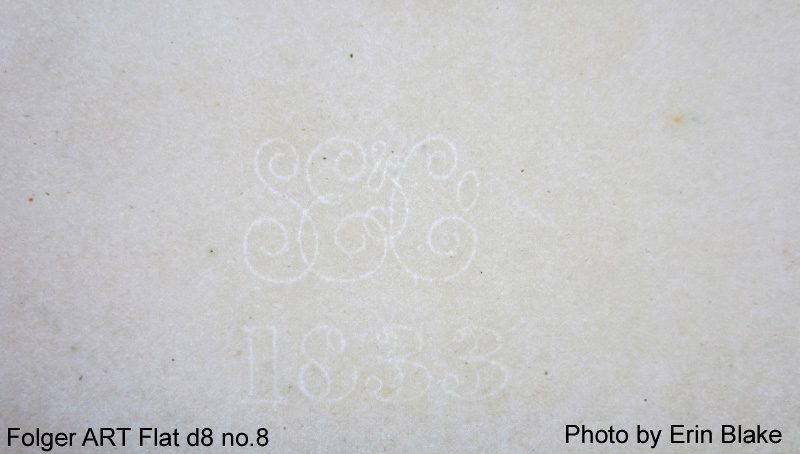
Check your reading
SE&Co. 1833. The first 3 sits directly below the knot of loops. Follow its two curves, then look just to the right for their twin. Someone could have written on this sheet in 1840. Could they have used it in 1830?
Even the mill had a little leeway with its calendar. As the Folger Shakespeare Library’s Erin Blake points out, a maker might keep using a dated design. A year could pass without anyone having to bend a new figure out of wire. Between the life of the tool and the life of a blank sheet, there are two opportunities for that date to fall behind.
Thirty years on the turn of a page
Thomas Orde began a travel journal in Paris in January 1772. His trip took him through France, Italy and Switzerland. Inside the cover is the bookplate of a Paris stationer. In the paper is another place and another year: Auvergne 1742. The two dates stand thirty years apart before the traveler has so much as left Paris.
It’s tempting to give that paper a little biography, perhaps a long wait on a stationer’s shelf. The bookplate doesn’t tell us when the stationer acquired it. What we have is more interesting than a guess about a shelf: a writer who supplies his own starting date and a sheet that gives a very different answer. You can check the two against each other. With Denys we have only one side of that comparison.
Then there’s Ann Daggett of Danby Wiske, England. Her will bears the date 23 April 1770. A surviving copy carries a second papermaker’s mark, Hagars 1819. Try putting those dates in order. Daggett could make her will in 1770. Someone could copy its wording onto another sheet half a century later, right down to the perfectly accurate date. Both years belong with that document. Each answers a different question.
Go back to the lead prices with Daggett’s will in mind. There are really three dates you might want: when somebody made the sheet, when Denys compiled the figures, and when those prices were in effect. Even finding the day he wrote them down wouldn’t settle the last question. A person making a list can look back. If you were entering those prices in a table of your own, the easiest mistake would be to put 1858 over a column of figures. The one place on the original where we can confidently put that year is in the paper.