Somebody missed a perfectly good opportunity to make change in Philadelphia in 1776. A sheet printed with four different fractions of a dollar survived in one piece. Hall & Sellers printed it. The American Antiquarian Society keeps it. Across the sheet the little bills still sit beside their neighbors, each with a border telling you where one piece of money ought to end and the next begin.
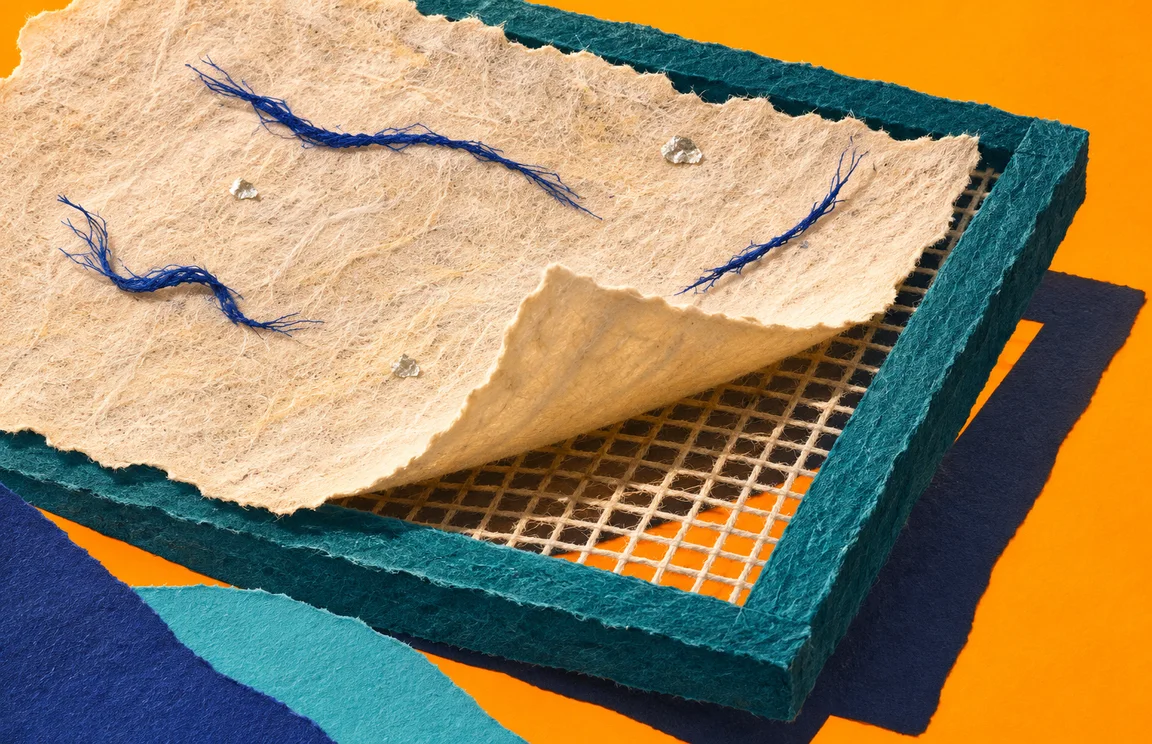
Imagine catching that sheet one trip earlier, on its way into the printing shop. The borders, the fractions and the little sundials all disappear. Two features survive the trip backward: blue fibers and flakes of mica. The Society identifies them in the paper supplied by Ivy Mills in Pennsylvania. The printer got them with the delivery.
That leaves an interesting job for anyone who wants to read old paper. Which marks arrived in the vat, which came from the tool that lifted the sheet out of it, and which had to wait for somebody with ink? A two-thirds-dollar note makes a good place to try your eye.

The blue curl and the bright flake
Cover the top half of the note with your hand. In the lower half you can still see three quite different sorts of line. The black type has tidy edges. The signature swoops across the page in a much warmer brown. The little blue curl wanders off on its own. The first two reward anybody who can read the words. The third takes a different sort of reading. How would you tell whether a blue line had been drawn with a pen or caught in the paper as a thread?
In 2023 a team led by Khachatur Manukyan at the University of Notre Dame took that question well beyond what a photograph can answer. Among the specimens they examined was a Pennsylvania twenty-shilling bill printed by Benjamin Franklin in 1739. Under magnification, blue strands had edges and widths of their own. Some ran for millimeters. The researchers detected indigo in blue fibers they analyzed. A colored pixel in the image above will get you looking in the right place. The evidence for the dye comes from measurements on the research specimens.
Where the fibers sat mattered, too. The team found them concentrated at the surface. Think what you would expect if you stirred a handful of colored threads through an entire vat: some ought to end up buried. The researchers proposed that wet, dyed material was scattered onto sheets before the final pressing and drying. They could examine the distribution a worker had left behind. The motion of that worker’s hand is their reconstruction.
Mica gives the eye a different job. It splits into very thin flakes with flat surfaces. Tilt a flake in a beam of light and a face that looked dull a moment ago can flash. A scan freezes one angle. A bright speck might be a mineral, a bit of pale fiber or simply the way the sheet was lit. On samples of early Pennsylvania currency the team used X-ray diffraction to identify the mica variety muscovite. That’s a fairly elaborate answer to a small question, but it lets us say what the flash was made of.
What the screen leaves behind
Take away the blue threads and the flakes and an ordinary writing sheet still has plenty to show. Picture a papermaker dipping a rectangular wire screen into watery pulp. Water drains between the wires. A skin of wet fibers collects across them. What looks like a single sheet going out of the vat is a record of thousands of small decisions about where water could pass and where a fiber could settle.
Bring a piece of old laid paper up to a window. Fine parallel lines run close together. Another set crosses them at much wider intervals. The first set follows the closely spaced wires that supported the pulp. The others follow the chain wires that held the fine wires in place. Turn the sheet a quarter turn. The whole arrangement turns with it. You’ve found the orientation of a tool that left the mill long before the paper reached your hands.
In the endpapers of a 1624 book about ciphers, a few lines run the unexpected way. Switch the light from the front of the sheet to the back and see if you can tell who put the squares there.
At the Folger Shakespeare Library in Washington, D.C., curator Erin Blake described a set of engravings offered as seventeenth-century work. The plates could make the old pictures again. The paper under the pictures presented a difficulty. It was modern laid paper, with the pattern produced by a later mould design. Someone had printed another set of impressions from older plates. A careful look at the spaces between the lines told Blake something the picture itself had kept quiet.
An extra bend in the wire
A papermaker could also fasten a bent piece of wire to the screen. Where its outline stood up, a little less pulp accumulated. Light coming through a dry sheet picks out that thin place. A maker with a length of wire could leave a name, a horn, a crown or a year. The device kept its shape when the worker took the sheet away, ready to put the same mark into the next one.
That repeat is useful. Find two sheets with similar crowns and you have a reason to look closer. Follow the bends and compare where the crowns sit against the chain lines. The more of the construction you can see, the more exact the comparison becomes. A year is an especially inviting clue, though it still leaves room for an old sheet to find a new use. An undated list of English lead prices shows just how much turns on that distinction.
Go back once more to the Philadelphia money. A printed border supplied a place to cut. Once somebody took the scissors to it, the neighbors disappeared, and each fraction of a dollar could go its separate way. The uncut sheet preserves the printer’s arrangement. A single loose bill still carries something the scissors couldn’t quite take away: its own little piece of the Pennsylvania mill.