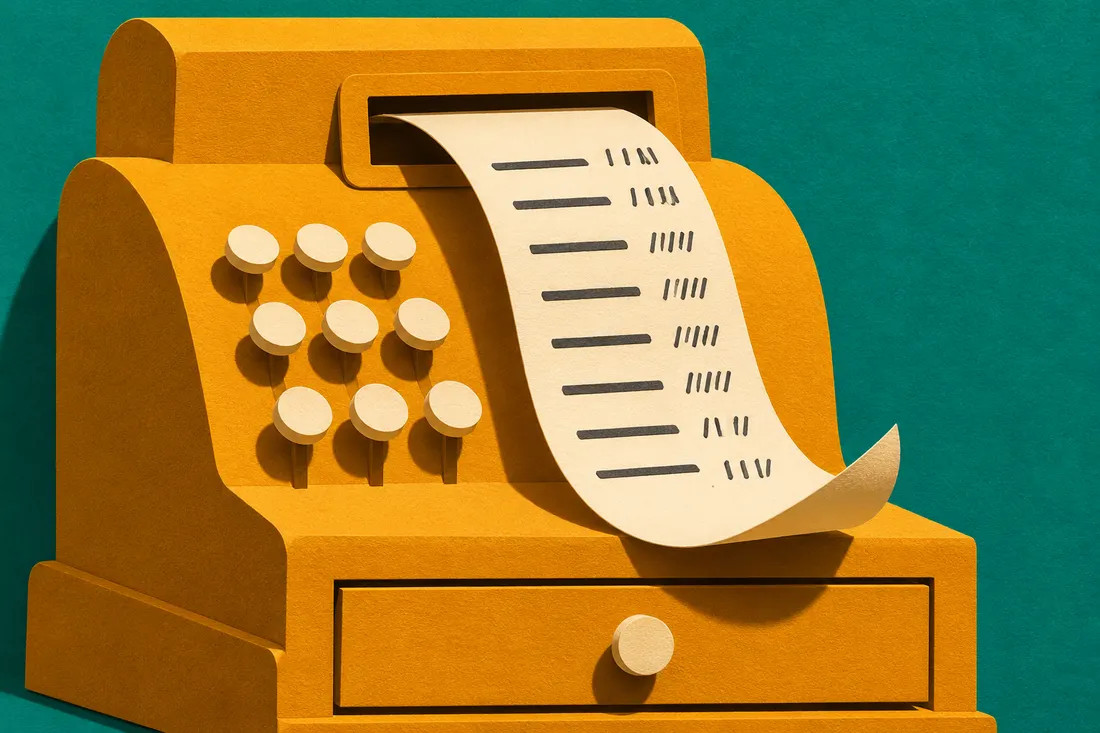
Somebody spent $1.25. We have a date, a ticket number, even a drawing of the machine that could issue the slip. What did the money buy? Take a look at the ticket marked Fig. 6 below. Turn it sideways if you like. The inventor gave you enough information to identify the sale and no way at all to identify the goods.
Edward B. Hess, a New York inventor, drew the specimen ticket for an 1893 U.S. patent. He wanted a reader to see exactly what his register would print. His choice makes a good starting point for a small mystery of the modern supermarket. How did the name of a thing find its way onto a piece of paper that once knew only the price?
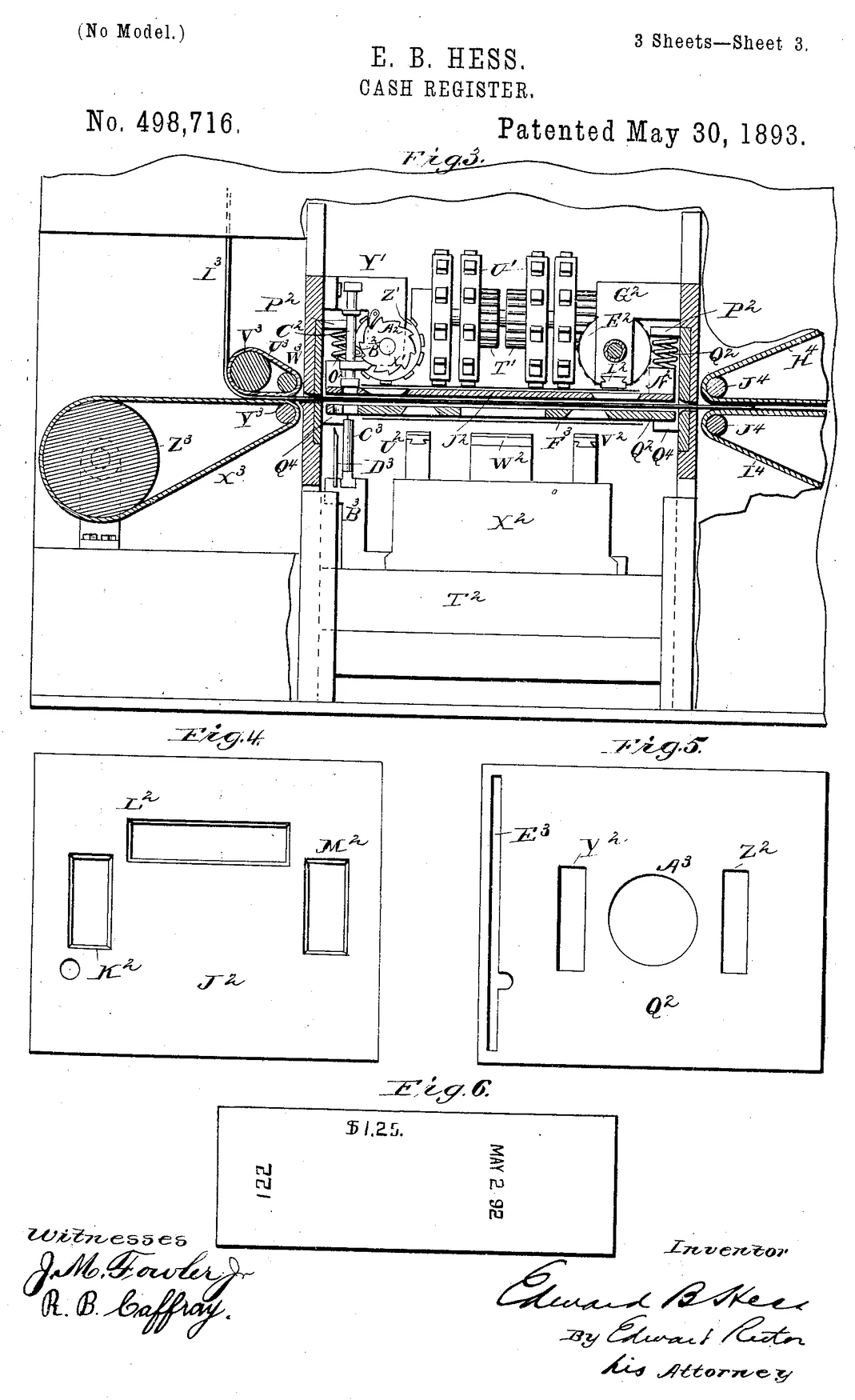
Show the detailHide the detail
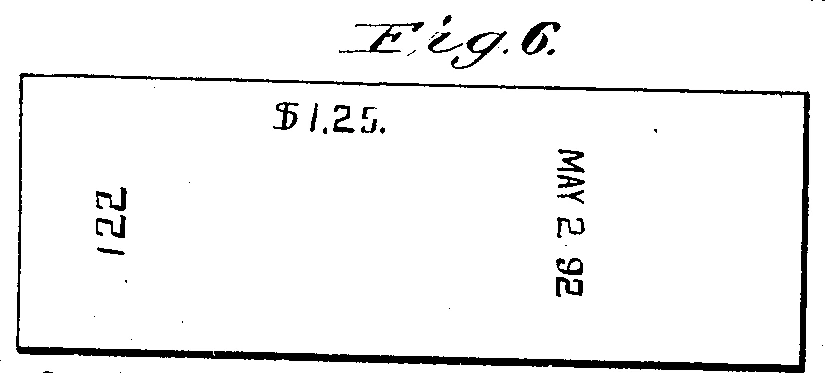
The $1.25 is the amount. Turn the ticket a quarter turn to read the other marks. The 122 counts the sale in sequence. May 2, 1892 is the example date. All three marks belong to the transaction. None names a product.
A number the customer could see
Think about a sale from the shopkeeper’s side of the counter. A customer hands over a coin. The clerk makes change. At closing time there’s money in the till, but how much ought to be there? A machine that registered the amounts as they came in could help answer that question without knowing whether anyone had sold a pound of coffee.
In Dayton, Ohio, the Ritty brothers’ commercial register used paper tape and numbers that popped into view. A customer could see the amount rung up while the purchase was still on the counter. The paper gave the business a record. Those jobs are easy to confuse when we call everything that comes out of a register a receipt. One audience was standing at the counter with change in hand. The other might come along hours later to check the day’s work.
Hess made that distinction a matter of where the paper went. In his design the printed strip could stay inside the register, or the machine could cut it into individual tickets. The same $1.25 would appear either way. In a continuous strip, its neighbors were the sale before and the sale after. Cut it loose and a customer could take home a dated record of the amount. The consecutive number survived the cut, a little piece of the day’s order carried away in somebody’s pocket.
The grocer who could spell out the order
Meanwhile, a pen could do something quite beyond those number wheels. In June 1911 the H. A. Fuller Company in what is now Bradenton, Florida, kept an account for M. H. Wyatt. The clerk wrote down lemons, corn, butter, and rice, tucked figures above the words, and fitted more than one date onto a line. In July the company made out the statement. Its total was $19.13. A handwritten mark at the foot records payment.
The Florida paper is eighteen years younger than the Hess patent, yet the operation that interests us here required no new invention. The clerk knew there was butter in the order and wrote butter. Wyatt could come back to that entry days later and recognize the purchase. A machine given only thirty-five cents could print the figure with perfect accuracy and still leave Wyatt wondering what it was for. That gap between an amount and a name would follow groceries right up to the checkout lane.
Send the basket to one counter
In 1917 Clarence Saunders received a patent for a store laid out around the shopper’s journey. His plan sent customers down rows of merchandise, around the ends, and on toward a particular exit. There the shopper set down a basket. An employee took out the goods, checked the purchases, and billed them. Saunders even numbered the adding machine on the plan. Among all the fixtures needed to guide a person through a store, it was number 100.
Notice where the work happens. Customers can choose different goods in different aisles, at their own pace. Every one of those choices comes back together at the narrow end of the trip. Someone there has to match the article in hand with a price, then move on to the next article while the next customer waits. An adding machine can make short work of the sum. Someone still has to tell it what to add. Looked at from that end of the store, a box that could introduce itself had a great deal to recommend it.
The gum and the 67 cents
On June 26, 1974, at a Marsh supermarket in Troy, Ohio, a ten-pack of Wrigley’s Juicy Fruit gum crossed a scanner. The price was 67 cents. The stripes on the wrapper did a rather particular job in that exchange. They identified the product. The store supplied the price.
The Smithsonian has one of the scanners from that installation. A laser inside the unit shone onto a rotating mirror that sent the beam up through glass in the counter. Reflected light from the package reached a detector. The connected register could use the signal to find the product in a stored file. That lookup is where the price a store charged and the words it used to describe a product could finally meet the paper coming out of the register. A cashier could set the pack down and move on without ever typing Juicy Fruit.
Imagine the gum going on sale the following week. The store could change the price in its file. The wrapper could carry on introducing the very same gum with the very same stripes. That’s a useful distinction the next time something rings up differently from the price on the shelf. A scanner can recognize the right product while the checkout has the wrong price for it.
Look at a grocery slip the way you looked at Hess’s little ticket. Find the amount and date, then put your finger over the item description. For a moment you’re holding a mystery worth $1.25, or 67 cents, or whatever you spent. Lift your finger. The surprisingly hard part was getting that word there.