Put four pinholes in a scrap of paper and hand it to a shopkeeper. What’s the take? Four nickels would make twenty cents. Four quarters would make a dollar. On an early cash register from Dayton, Ohio, both answers were possible. To settle the question, the shopkeeper needed to know where the holes fell.
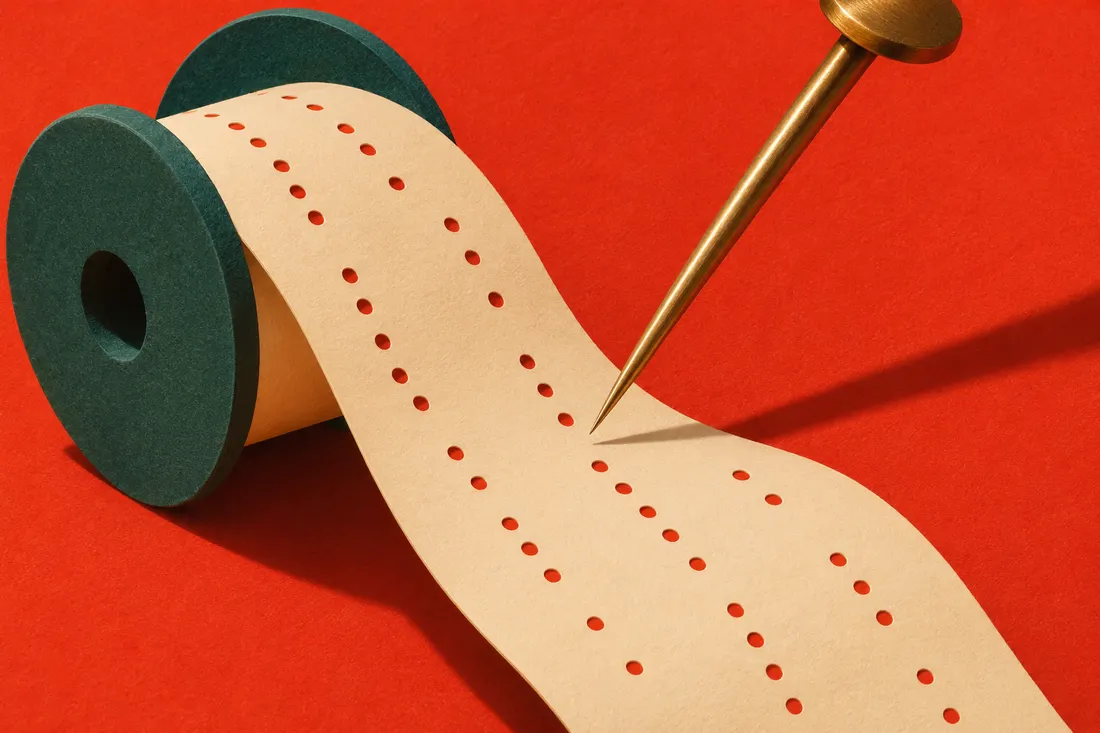
This was the paper-roll machine associated with James Ritty, a Dayton saloonkeeper. Its paper stretched sideways across the keys. A pin belonged to each key, and each key stood for an amount of money. Press the key and its pin pierced the paper in that key’s column. The roll moved along one step, leaving a fresh place for the next mark. A ten-cent sale followed by another ten-cent sale left two holes, one behind the other.
The machine could make a record like that without putting ink on the paper. The shopkeeper supplied the arithmetic. Try the four marks already on the strip below. Read down the ten-cent column first, then see what the other two columns contribute. You can also punch a few sales of your own. The amounts here are ours. The trick of giving a hole its value by where it lands belonged to the machine.
A working illustration with three denominations. Each row records one keypress.
| Row | 5¢ | 10¢ | 25¢ |
|---|---|---|---|
| 1 | Punch | Punch | Punch |
| 2 | Punch | Punch | Punch |
| 3 | Punch | Punch | Punch |
| 4 | Punch | Punch | Punch |
| 5 | Punch | Punch | Punch |
| 6 | Punch | Punch | Punch |
| 7 | Punch | Punch | Punch |
| 8 | Punch | Punch | Punch |
Count the take
10 + 5 + 25 + 10 = 50 cents.
What the customer saw
Imagine two people watching a dime change hands. The customer wants to know that the clerk entered ten cents. The proprietor, who might be away at dinner, wants to know the same thing two hours later. The Rittys’ commercial machine had numbers that rose into view for the first person and paper that kept the mark for the second. The next sale could displace the ten from the display. Its hole stayed where it was.
It’s easy to come away with the wrong picture if you begin with the patent drawing. James and his brother John had patented a different arrangement in 1879. Its hands pointed to amounts on a dial, and numbered disks inside the case kept a running total. The patent even described a bell connected to the keys. A customer who heard it had a cue that the clerk had worked the mechanism. The paper-roll version gave the proprietor a strip to unroll and read after the customer had gone home.
The shopkeeper still had a job
John H. Patterson, who went on to run the National Cash Register Company, remembered having to explain the device to prospective buyers. Writing in 1918, he described taking a model with just three keys into cafés and grocery stores. The full-size machine was a considerable thing to carry on a sales call. Three keys were enough to let someone press one, make a mark, and understand the proposition. Patterson didn’t specify their denominations, so our illustration uses a nickel, a dime, and a quarter.
At closing, the proprietor could work down one column at a time. Six holes under ten cents came to sixty cents. It made no difference how many nickel sales had come between the dimes. Those would get their own count one column over. And if the proprietor lost count halfway through, the paper was still there for a second pass. The test came when the amount recorded for sales was set alongside the money actually taken in.
There was a hitch that no amount of precision in the paper feed could cure. Someone had to press a key. Patterson recalled going back to stores where registers were on trial to see whether the clerks were actually using them. Some clerks resented what the machine implied about their honesty. A shopkeeper persuaded to buy the thing and a clerk willing to use it were two separate victories for the salesman.
Look once more at the ten-cent column. A hole there says a hand reached for the ten-cent key. It can’t tell you what the customer carried out, whether the right change came back, or even whether a dime ever crossed the counter. It preserves one small, checkable part of a sale. Everything else that happened around that hole still belonged to the people in the shop.