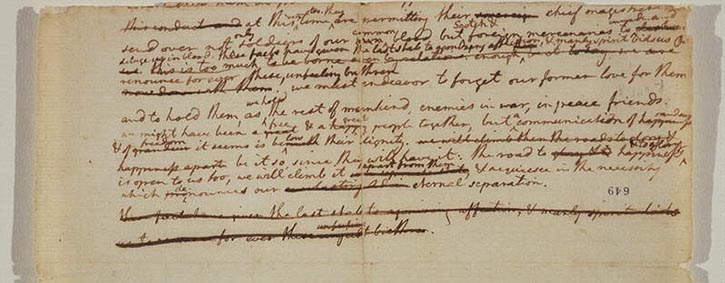
Thomas Jefferson folded this scrap into thirds so he could pocket it. By then he had already crowded the paper with revisions. Words squeeze in above the writing, phrases run into the margin, and two lines near the foot have been crossed through with enough ink to settle the matter. If you wanted to match it to another draft of the Declaration of Independence, there would be plenty to read.
Linda Morenus, a paper conservator at the Library of Congress in Washington, D.C., had a question the handwriting couldn’t answer. What if the two drafts had something in common before Jefferson ever picked up his pen?
A mark that runs right off the edge
Jefferson drafted the Declaration in Philadelphia in June 1776. The Library holds this piece of his early composition and the fuller manuscript he called his rough draft. The first sheet of that later draft has a particularly obliging feature: an oval ribbon watermark with a Latin inscription. The small fragment has no such mark. Take a rectangle out of a sheet with a watermark in one corner and you can see how easily the maker’s emblem goes missing.
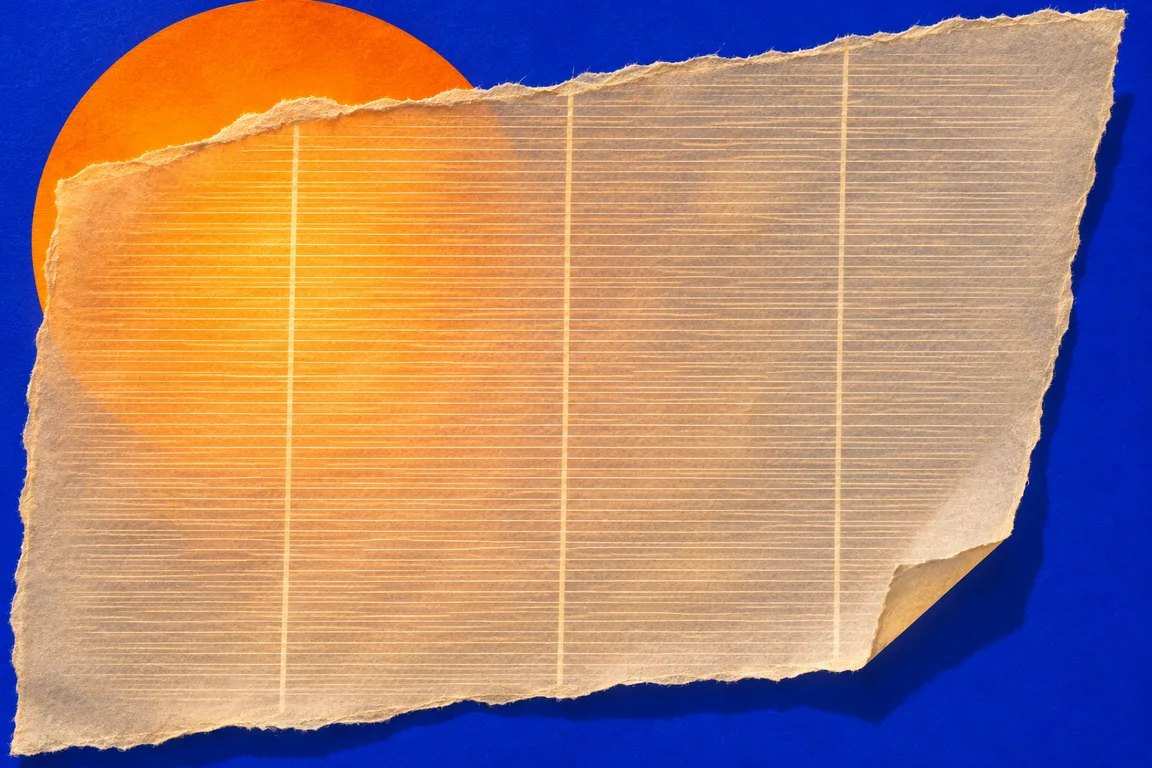
Something else extends across the whole sheet. An eighteenth-century papermaker dipping a mould into a vat needed a surface fine enough to catch wet fibers and open enough to let the water run out. A row of thin wires laid very close together did that job. More widely spaced wires running across them tied the fine wires together over the supporting ribs. Lift the wet sheet from the mould and all that metal stayed at the mill. Its pattern went wherever the paper went.
Hold laid paper to the light and the fine stripes are called laid lines. The widely spaced ones that cross them are chain lines. Less pulp collected over the wire than in the gap beside it, so a little more light can come through where the wire lay. Paper turned sideways in a book still carries the same two sets of marks. Count by spacing and by the way one set crosses the other, and you can read a sheet whichever way the binder put it in.
Counting the gaps
Morenus placed the two manuscripts side by side. She used a fiber-optic light source that let her shine light through the paper without exposing it to heat. Now she could count the lines and measure the distance between them. A clipped piece of paper had lost its share of the ribbon, but the papermaker had obligingly repeated the other evidence all the way to the edges.
The arrangement on the fragment and the rough draft looked sufficiently alike for Morenus to place the papers at what appeared to be the same mill. That’s an interesting distance to travel from a few pale stripes, and a good place to stop. Paper from one mill could leave in many separate sheets. The comparison supplies no torn edges to fit together. Nor does it put a mill in Philadelphia just because Jefferson sat down to write there. The Library’s account cites historian Julian Boyd’s judgment that the paper was probably Dutch.
The words give us a second comparison, one we can make without a lamp. The Library counted 148 words that survived Jefferson’s editing on the fragment. Every one made it into the rough draft. The deleted words dropped out. Follow the ink and you can watch Jefferson decide what the new document would say. Follow the lines under his hand and you get a glimpse of the person who made it possible to write anything there at all.